Tuesday, January 24, 2023

Treadle Make Tuesday: Shawn's Linen Coat

It's something NEW! Every Tuesday we've been sharing projects from Treadle Yard Goods employees (a.k.a. The Treadlettes!) and while that's been a ton of fun, we want to expand.

Now we're also sharing projects made by YOU!

If you follow us on Instagram, you might be aware of the #mytreadlemake tag. Anyone can use this tag to share something they're made with our fabric, buttons, or notions, in our classes, or just with our advice and support!

Shawn made this fantastic coat over the course of a few classes with us at Treadle.


She used one of our gorgeous linens, paired with a small amount of Liberty Tana Lawn print for some adorable hidden details! 


The pattern is the Merchant and Mills September coat, and this is Shawn's second version of it! 

Friday, January 20, 2023

Friday Fun Fact: What's that presser foot?

Today we're doing a round of everyone's favorite game: What's that presser foot?

Your machine probably came with a bunch of presser feet, or maybe you inherited a big old sewing box full of weird old stuff, including some mystery feet. Let's explore some of them!

Depending on the machine, the way the feet attach might be quite different - such as snap-on vs. with a shank -  but the basic function stays the same.

First you'll see a selection of ordinary all-purpose feet. They have a wide oval center to allow for zigzag stitching and multiple needle positions.


Next we have two straight-stitch feet. These are handy for sewing delicate fabrics. When paired with a straight-stitch throat plate, they can really help prevent fabric getting sucked into the machine!

Also note that some straight stitch feet are made for measuring accurate 1/4" seams, and some aren't. Measure your foot to be sure!


Most machines need a special foot to make buttonholes. If it's a big long rectangle, it's probably your buttonhole foot! You need the correct one for your machine to make the buttonhole function work, especially on modern machines with 1-step buttonholes.


Finally, we've got these weird little blue guys. They're meant for sewing buttons on by machine! You set your stitch to a wide, very short zigzag and place the button under the foot. The rubbery blue bit helps hold the button in place while you sew.


There are tons of presser feet out there, so we'll be exploring more of them in an upcoming Fun Fact!

Check out all our Friday Fun Facts in the archive here!

Tuesday, January 17, 2023

Treadle Make Tuesday: Sabrina's Scout Tee

Check out this sweet share from Instagram. Sabrina made this cute linen top from the Scout Tee pattern with one of our lovely checked linens.


Friday, January 13, 2023

Friday Fun Fact: Hand vs. Machine needle sizing

This question came up in the store the other day: Why are hand sewing needles sized differently from machine needles?

Hand sewing needles have been made for thousands of years, and the kind we are familiar with are based on wire. First you make the metal into wire, then you flatten one end and punch a hole. That's a needle!

Because they started out as wire, hand sewing needles use a sizing system similar to wire gauge sizes.

The important thing with hand needles: bigger number = smaller needle.


In the pack of needles pictured, the size 3 are the big ones in the middle, and the size 9 are the little ones on the ends. 

Machine sewing needles are the opposite: bigger number = bigger needle! 

And if that's not confusing enough, there are two different systems for sizing machine needles! That's why we get numbers like 80/12 and 90/14.


SCHMETZ is a German company and uses the metric system.  To determine needle size, SCHMETZ measures the diameter of the blade resulting in numbers like 80, 90, etc...  But SCHMETZ is not the only needle manufacturer.  Other companies use sizing systems often referred to as Asian, International, or Singer sizing.  Years ago the needle manufacturers standardized the sizing so a metric size 80 always equals a size 12, 90 = 14, etc.

We hope that clears it up for you!

There's more to choosing the right needle than the size! Click here to see our post on needle selection!

Tuesday, January 10, 2023

Treadle Make Tuesday: Bethany's Wedding Dress

It's something NEW! Every Tuesday we've been sharing projects from Treadle Yard Goods employees (a.k.a. The Treadlettes!) and while that's been a ton of fun, we want to expand.

Starting this week, we're also sharing projects made by YOU!

If you follow us on Instagram, you might be aware of the #mytreadlemake tag. Anyone can use this tag to share something they're made with our fabric, buttons, or notions, in our classes, or just with our advice and support!

This week we're sharing an amazing handmade wedding dress from Bethany @putteringwithpaper


She used the Cashmerette Upton pattern paired with our silk noil and hand-embroidered the floral designs. 

See the full post with all the details here at her Instagram!

Want to be featured? Share your make with us on Instagram, Facebook, by email, or just stop by the store! We will always ask your permission before we share.


Friday, January 6, 2023

Friday Fun Fact: Triple Zigzag Stitch

Yay, Friday Fun Facts are BACK after our holiday hiatus!

Today I'm sharing one of my favorite stitches with you: the triple zigzag.

In a basic zigzag stitch, the needle makes one stitch for each leg of the zigzag. In the triple zigzag stitch, there are three stitches in each leg.


Most machines made in the last 30 years have this stitch! The stitch selector below is from our Eversewn Jasmine - see the triple zigzag in the circle?


Here's why this stitch is so helpful to us: less tunneling, less waving, and more stretch. Let's explore that!

Tunneling is what happens when a zigzag stitch draws up in a fold, creating a ridge (or "tunnel") in the center of the stitch line. The triple zigzag doesn't do that!

Check out the orange sample below with seam allowances pressed open - the seam allowance on the left is finished with a traditional zigzag, while the one on the right is finished with the triple. Generally the triple gives you a smoother, flatter finish.


On a sturdy fabric, this is less noticeable, but the difference becomes more apparent on a delicate fabric. The same two edge finishes were applied to the gauzy white fabric - regular zigzag on the left, triple on the right.


Can you see how the regular zigzag crumples the fabric's edge? In this case, the triple is the best choice!

Triple zigzag is also a great choice for hemming knits! If you've experienced waving or "potato chip edge" while hemming knits, try the triple zigzag for a nice flat finish!


Plus, this stitch has way more stretch to it than the regular zigzag, making it perfect for tight hems, like at the bottoms of snug leggings. You won't pop a stitch out when you stretch that hem!

Read all our previous Friday Fun Facts here at our blog!

Friday, December 2, 2022

Friday Fun Fact: Were people smaller in the past?


It's Elizabeth here, and if you've ever talked to me for more than five minutes, you've probably heard me talk about historical dresses.

Today I want to share one of my favorite LOCAL dresses with you, and do a little historical size myth-busting.

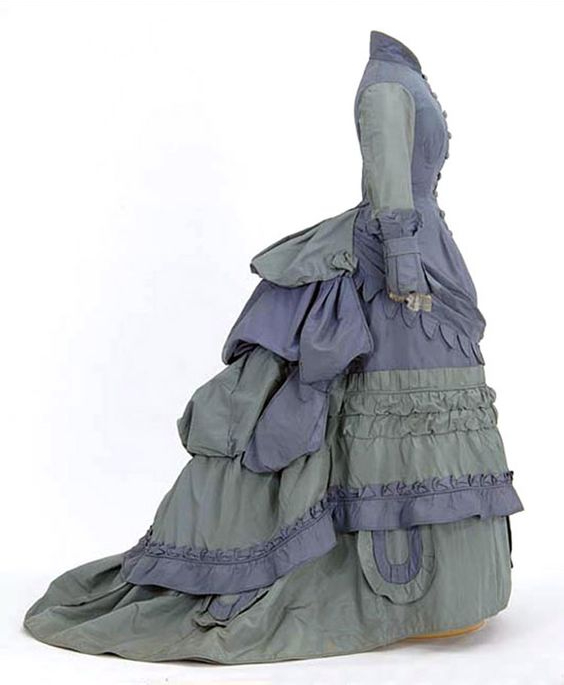
This dress was made in the early 1870s right here in St. Paul, Minnesota!


You can see all the details on this dress at the Minnesota Historical Society page here. If you click through you will notice the measurements, including a 22" waist.

I know what you're thinking. "Wow! That's really small! Women were so much smaller back then!"

But the reality is, no, they really weren't!

Human bodies have always come in many shapes and sizes, and while corsets may reduce a waist by a few inches, they can only do so much.

But why are there so many small dresses?

The reason is simple: the small dresses survive because no one can wear them.


Our great-grandmothers were frugal and practical, and so were theirs, and so were theirs. Fabric was valuable and precious, and a good dress would not be packed away and saved for no good reason.

Items of clothing were worn out, mended, sold, refashioned, handed down, picked apart, and remade until there was nothing left.

But if a dress is very small, there's no one to hand it down to. A tiny dress that doesn't fit anyone gets saved in a trunk for a hundred years and then donated to a historical society.

We can confirm this by looking at the many photos and portraits from the era. Sure, there are plenty of slender women, but there's more diversity than you might think - like the lovely, curvy lady in the photo below.